


You take your supplements religiously every single day, convinced that consistency equals results. Yet many athletes discover their pre-workout feels less effective after months of daily use, or their adaptogen stack no longer delivers the same stress relief. The truth is that your body adapts to continuous supplementation through receptor downregulation and hormonal adjustments, gradually diminishing returns. Supplement cycling offers a strategic solution, using planned breaks to maintain effectiveness whilst supporting your body’s natural rhythms. This guide explains the science behind cycling, identifies which supplements benefit from breaks, and provides practical protocols to optimise your performance and recovery.
Table of Contents
- The Science Behind Supplement Cycling
- Which Supplements Benefit From Cycling And Which Do Not
- How To Create An Effective Supplement Cycling Plan
- Benefits Of Supplement Cycling For Athletes’ Performance And Wellbeing
- Elevate Your Supplement Routine With Expert Products
Key takeaways
| Point | Details |
|---|---|
| Cycling prevents tolerance | Strategic breaks reset receptor sensitivity, maintaining supplement effectiveness over months and years of use. |
| Not all supplements need cycling | Creatine, vitamins, minerals, and omega-3s work best with continuous daily intake rather than scheduled breaks. |
| Aligns with natural rhythms | Cycling respects circadian and hormonal cycles, supporting biological intelligence rather than creating dependency. |
| Protects long-term health | Planned breaks reduce side effect risks and prevent downregulation of critical hormonal pathways. |
| Enhances training adaptation | Cycling protocols can synchronise with periodised training for optimal performance gains and recovery. |
The science behind supplement cycling
Your body possesses remarkable adaptive mechanisms that respond to external inputs, including supplements. When you introduce a compound consistently, cellular receptors adjust their sensitivity and number to maintain homeostasis. This process, called receptor desensitisation, explains why supplement cycling helps prevent tolerance, keeping your supplements working effectively over time. Without strategic breaks, you may find yourself needing higher doses to achieve the same results, or worse, experiencing diminished benefits altogether.
Hormonal pathways particularly benefit from cycling protocols. Adaptogens like ashwagandha and rhodiola influence cortisol and stress response systems. Whilst these compounds excel at supporting acute stress, continuous use can lead to hormonal pathway downregulation, reducing their effectiveness. Your endocrine system thrives on dynamic inputs rather than constant stimulation. Cycling allows these pathways to reset, maintaining their responsiveness when you genuinely need support during intense training blocks or high-stress periods.
Beyond receptor dynamics, cycling respects your body’s natural rhythms. Your physiology operates on multiple timescales: circadian rhythms govern daily patterns, ultradian cycles affect hormone pulses throughout the day, and monthly variations influence everything from immune function to recovery capacity. Cycling supplements supports these biological rhythms, promoting resilience rather than dependency. When you align supplement intake with these natural cycles, you enhance your body’s innate intelligence rather than overriding it.
Strategic breaks also protect against side effects that accumulate with prolonged use. Even well-tolerated supplements can stress metabolic pathways when taken continuously. Your liver processes compounds, your kidneys filter metabolites, and your digestive system manages absorption. Cycling provides recovery windows for these systems, reducing cumulative burden whilst maintaining supplement benefits. This approach proves particularly valuable for athletes pushing physiological limits through training, where every system requires optimal function.
“Cycling supplements can support natural rhythms, promoting biological intelligence rather than dependency, which enhances long-term resilience and effectiveness.”
The concept extends beyond individual supplements to your entire stack. When you stack supplements safely, cycling becomes even more critical. Multiple compounds affecting similar pathways can compound adaptation effects. A strategic cycling approach considers interactions, timing each supplement’s breaks to maintain overall benefits whilst preventing system-wide downregulation. This sophisticated method requires planning but delivers superior long-term results compared to continuous, unchanging supplementation.
Which supplements benefit from cycling and which do not
Understanding which supplements require cycling versus continuous use empowers you to design an effective regimen. Not every compound in your cabinet needs scheduled breaks. Some supplements work through mechanisms that benefit from daily consistency, whilst others lose effectiveness without strategic cycling. This distinction fundamentally shapes how you approach supplementation for performance and recovery.
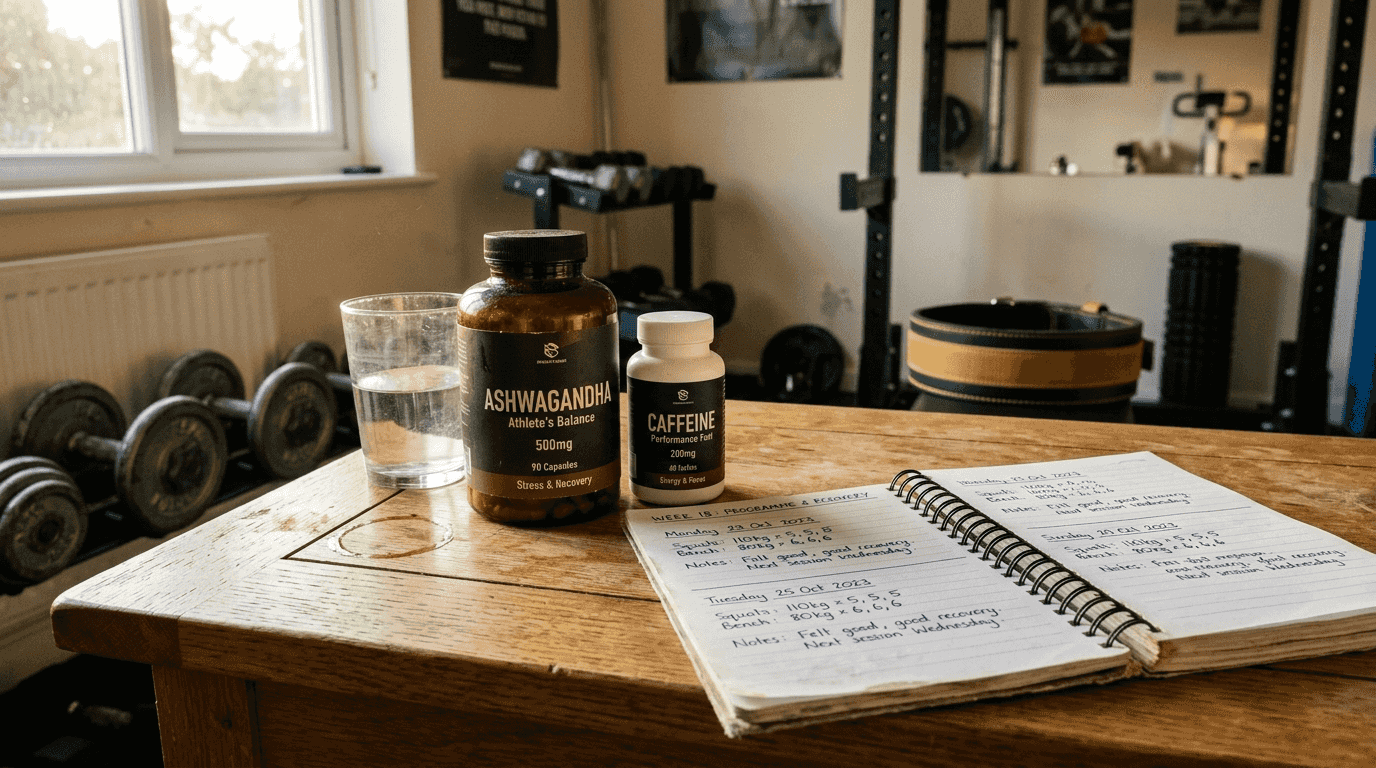
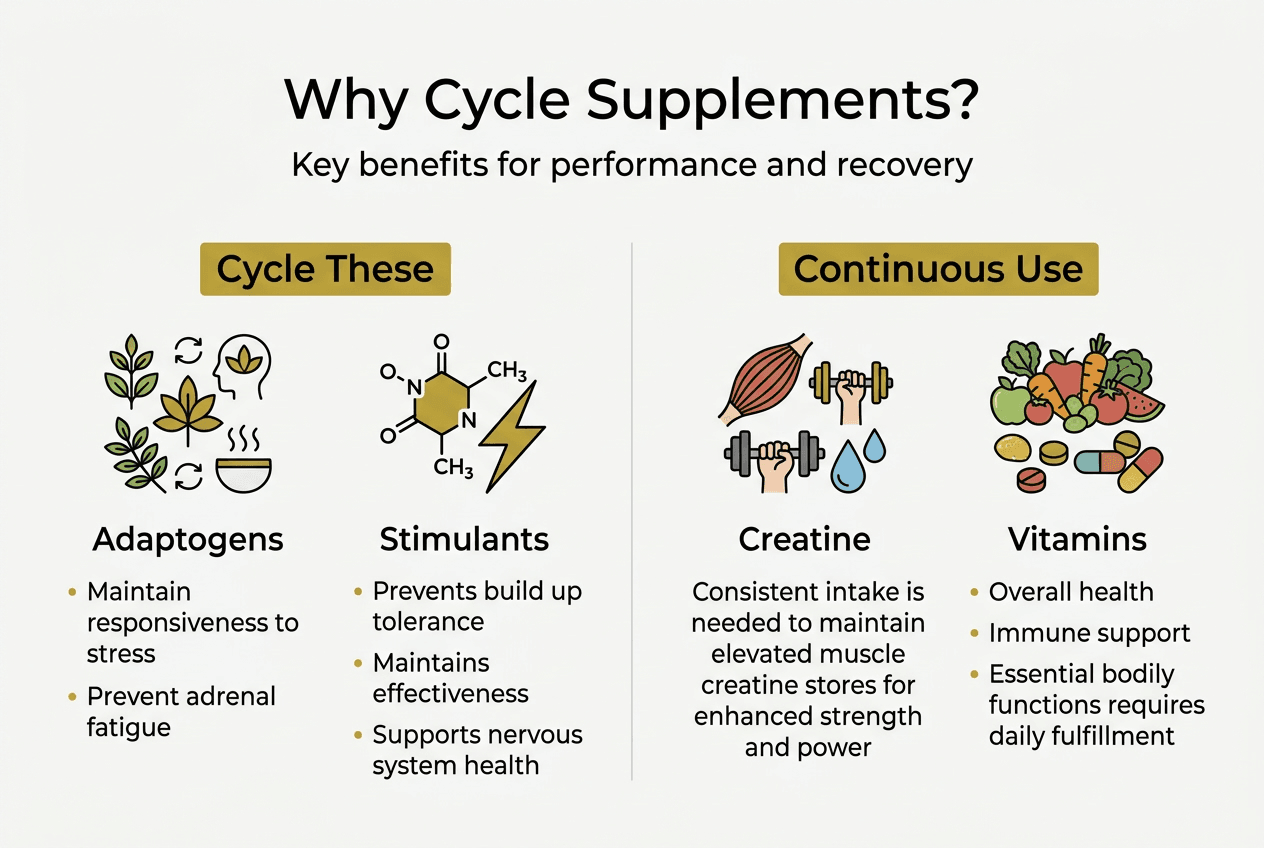
Adaptogens and stimulants top the list for cycling requirements. Adaptogens like ashwagandha and rhodiola benefit from cycling because they modulate stress response systems that adapt to continuous input. Similarly, caffeine tolerance resets with cycling, allowing you to maintain effectiveness at lower doses. These compounds directly influence receptor sensitivity, making breaks essential for sustained benefits. A typical protocol involves 6-8 weeks of daily use followed by 2-4 weeks off, though individual responses vary.
Sleep aids present another category requiring careful cycling. Melatonin supplementation can suppress natural production when used continuously. Your pineal gland adjusts output based on external melatonin presence, potentially creating dependency. Cycling melatonin preserves your body’s ability to produce adequate amounts naturally. Use it strategically during travel, shift work, or acute sleep disruptions rather than as a permanent solution. This approach maintains effectiveness whilst supporting long-term sleep health.
Conversely, several supplement categories perform best with continuous intake. Creatine, vitamins, minerals, omega-3s, and collagen do not require cycling. These compounds work through saturation or deficiency correction mechanisms rather than receptor-mediated pathways. Creatine saturates muscle stores, requiring consistent intake to maintain elevated levels. Vitamins and minerals address nutritional gaps that persist regardless of cycling. Omega-3 fatty acids incorporate into cell membranes over time, benefiting from steady intake. Collagen supplements provide amino acids for connective tissue repair, a continuous need for active individuals.
| Supplement category | Cycling recommendation | Typical protocol | Reason |
|---|---|---|---|
| Adaptogens | Yes | 6-8 weeks on, 2-4 weeks off | Prevents receptor desensitisation |
| Stimulants | Yes | 5 days on, 2 days off | Maintains effectiveness at lower doses |
| Sleep aids | Yes | Use only when needed | Preserves natural production |
| Creatine | No | Daily continuous use | Works through saturation |
| Vitamins and minerals | No | Daily continuous use | Addresses ongoing deficiencies |
| Omega-3s | No | Daily continuous use | Requires consistent intake for benefits |
| Collagen | No | Daily continuous use | Supports continuous tissue repair |
Immune modulators require special consideration. Compounds like echinacea or high-dose zinc work best for short-term immune challenges rather than daily prevention. Continuous use can overstimulate immune responses or create imbalances. Reserve these supplements for acute situations, using them for one to two weeks maximum. This targeted approach maintains effectiveness whilst avoiding immune system confusion from constant stimulation.
Pro Tip: Schedule your cycling based on training periodisation. Take adaptogens during high-volume training blocks when stress is elevated, then cycle off during deload weeks. This synchronisation maximises benefits whilst respecting your body’s recovery needs. Similarly, muscle recovery supplements can align with intense training phases, with strategic breaks during maintenance periods.
How to create an effective supplement cycling plan
Designing your cycling protocol starts with honest assessment of your goals and current supplement regimen. List every supplement you take, noting dosage, timing, and purpose. Identify which compounds fall into cycling categories versus continuous use. This inventory provides the foundation for strategic planning, revealing patterns and potential conflicts in your current approach. Consider your training schedule, competition timeline, and recovery priorities when structuring cycles.
Common cycling protocols offer proven frameworks to guide your planning. The 5 days on, 2 days off approach works excellently for stimulants and some adaptogens, providing regular breaks without extended gaps. Monthly cycles suit compounds requiring longer saturation periods, typically involving 3-4 weeks of use followed by 1-2 weeks off. Individual goals determine cycling approaches, with some athletes preferring seasonal patterns aligned with competition schedules. Choose protocols matching your lifestyle and training demands for sustainable adherence.
- Assess your supplement stack and identify compounds requiring cycling versus continuous use.
- Select appropriate cycling protocols based on supplement type and your training schedule.
- Plan break periods strategically, avoiding simultaneous cycling of multiple key supplements.
- Monitor your body’s responses through training logs, noting energy, recovery, and performance markers.
- Adjust cycle length based on feedback, extending or shortening phases as needed for optimal results.
- Schedule cycling around competition and peak training blocks to maintain support when most needed.
Planning breaks requires strategic thinking beyond simple calendar dates. Avoid cycling multiple critical supplements simultaneously, which could compromise training quality or recovery. Stagger breaks so you maintain baseline support whilst individual compounds reset. For instance, cycle your adaptogen during a recovery week whilst maintaining continuous creatine and omega-3 intake. This approach prevents performance gaps whilst achieving cycling benefits.
Monitoring becomes crucial for optimising your protocol. Track subjective markers like energy levels, sleep quality, stress resilience, and training performance. Note when supplements feel less effective, signalling potential tolerance development. Objective measures such as training volume, recovery heart rate, and body composition provide additional feedback. This data informs adjustments, helping you refine cycle length and break duration for your unique physiology.
Pro Tip: Keep a supplement journal documenting what you take, when you cycle, and how you feel throughout each phase. After several cycles, patterns emerge revealing your optimal protocols. This personalised data proves far more valuable than generic recommendations, as individual responses vary significantly. Choosing supplements for performance becomes more effective when guided by your tracked experience rather than marketing claims.
Benefits of supplement cycling for athletes’ performance and wellbeing
Maintaining supplement effectiveness stands as the primary benefit of strategic cycling. When you prevent tolerance through planned breaks, your supplements continue delivering results month after month, year after year. Athletes who cycle appropriately often find they need lower doses to achieve desired effects compared to continuous users requiring escalating amounts. This efficiency saves money whilst reducing metabolic burden, a win for both your wallet and your body. Cycling prevents tolerance and dependency by allowing adaptive mechanisms to reset, preserving supplement potency indefinitely.
Reduced side effects represent another significant advantage. Many supplements carry minimal risks at appropriate doses but can cause issues with prolonged use. Cycling mitigates cumulative effects, giving your body recovery windows to process and eliminate compounds. This proves particularly valuable for liver-metabolised supplements or those affecting hormonal pathways. Athletes pushing physiological limits already stress these systems through training. Cycling supplements reduces additional burden, supporting overall health alongside performance goals.
Hormonal and receptor balance directly impacts athletic performance. Your body’s signalling systems require dynamic inputs for optimal function. Continuous supplementation can flatten these natural variations, reducing responsiveness over time. Cycling restores normal fluctuations, maintaining the sensitivity that allows your body to respond appropriately to training stimuli. This balanced state enhances adaptation, helping you gain more from each workout whilst recovering more effectively between sessions.
Natural regulation benefits extend beyond immediate performance. When you cycle supplements strategically, you prevent dependency that can develop with continuous use. Your body maintains its ability to produce neurotransmitters, hormones, and other compounds without external support. This resilience proves invaluable during periods when supplementation isn’t possible, such as travel or competition restrictions. Athletes who cycle appropriately adapt better to changing circumstances, maintaining performance consistency regardless of supplement access.
Creatine represents a notable exception worth highlighting. Creatine supplementation increases muscle stores by about 20%, enhancing power output and recovery capacity. Unlike adaptogens or stimulants, creatine works through saturation rather than receptor pathways, requiring continuous intake to maintain elevated muscle stores. This mechanism means creatine doesn’t require cycling for effectiveness. Understanding these distinctions allows you to apply cycling where beneficial whilst maintaining continuous use of compounds that require it.
Aligning cycling with training periodisation amplifies benefits. During high-volume phases, adaptogenic support helps manage stress and maintain recovery capacity. During deload weeks, cycling off allows natural systems to reset. This synchronisation creates a powerful synergy between supplementation and training, each enhancing the other. Supplement quality becomes even more critical in this context, as pure, effective compounds deliver consistent results that inform your cycling decisions. Premium supplements from reliable sources ensure you’re making protocol adjustments based on true physiological responses rather than product inconsistencies.
The cumulative effect of proper cycling extends throughout your athletic career. Short-term benefits compound into long-term advantages, preserving supplement effectiveness for years rather than months. This sustainable approach supports consistent progress, avoiding the plateau many athletes experience when tolerance develops. Stacking supplements for recovery becomes more effective when cycling principles guide your protocol, creating a comprehensive strategy that respects your body’s adaptive capacity whilst maximising performance gains.
Elevate your supplement routine with expert products
Strategic supplement cycling requires premium products that deliver consistent results, allowing you to accurately assess responses and optimise protocols. Elevate Supplements offers science-backed formulations designed for serious athletes who demand quality and effectiveness. Whether you’re implementing cycling protocols for adaptogens or maintaining continuous intake of foundational supplements, our catalogue provides solutions tailored to your performance and recovery needs.
Explore our complete supplement collection to build your personalised stack. Our pure creatine monohydrate provides the continuous support your muscles need without cycling requirements, whilst our Elevate Energy pre-workout offers clean stimulation perfect for strategic cycling protocols. Every product undergoes rigorous testing to ensure purity and potency, giving you confidence in your supplementation decisions. Fast UK and Ireland delivery, free shipping over £100, and 24/7 support make optimising your routine straightforward and convenient.
FAQ
What is supplement cycling and why is it important?
Supplement cycling involves taking scheduled breaks from certain supplements to prevent tolerance and maintain their effectiveness over time. This practice allows your body’s receptors and hormonal pathways to reset, ensuring supplements continue delivering benefits rather than diminishing returns. Cycling proves particularly important for adaptogens, stimulants, and sleep aids that directly influence receptor sensitivity.
Which supplements should I cycle and which should I take continuously?
Adaptogens like ashwagandha and rhodiola, stimulants including caffeine, and sleep aids such as melatonin typically require cycling to maintain effectiveness. These compounds influence receptor-mediated pathways that adapt to continuous use. Conversely, creatine, vitamins, minerals, omega-3 fatty acids, and collagen work best with daily continuous intake, as they function through saturation or deficiency correction mechanisms rather than receptor pathways.
How do I know the best cycling schedule for my supplements?
Start with established protocols like 5 days on and 2 days off for stimulants, or 6-8 weeks on followed by 2-4 weeks off for adaptogens. Monitor your body’s responses through training logs, noting energy levels, recovery quality, and performance markers. Adjust cycle length based on this feedback, extending or shortening phases to match your individual physiology and training demands. Consulting with sports nutrition professionals can provide additional personalised guidance.
Can cycling supplements improve long-term athletic performance?
Yes, cycling preserves supplement effectiveness by preventing tolerance, ensuring compounds continue supporting performance over months and years. This approach reduces side effects from prolonged use whilst maintaining hormonal and receptor balance critical for training adaptation. Cycling also aligns supplement intake with periodised training, providing support during intense phases whilst allowing natural recovery during deload periods. The cumulative effect supports consistent, sustainable progress throughout your athletic career.
Recommended
- Recovery supplements to boost muscle repair in 2026 – ElevateSupplements
- Why stack supplements for peak performance and recovery – ElevateSupplements
- Why supplement quality matters for athletes in 2026 – ElevateSupplements
- Why choose clean supplements for athletic performance in 2026 – ElevateSupplements


