


TL;DR:
- The effectiveness of amino acids depends on timing and specific profiles, not just total protein intake.
- EAAs, especially leucine, are more effective for muscle synthesis than isolated BCAAs.
- Precise amino acid strategies optimize recovery, making targeted supplementation crucial for athletes.
Most athletes know protein matters for recovery. Far fewer understand that which amino acids you consume, and when, makes the difference between a 48-hour turnaround and dragging through your next session. The blanket advice to “eat more protein” misses the point entirely. Amino acids, particularly EAAs and BCAAs, stimulate muscle protein synthesis and reduce muscle damage in ways that generic protein sources simply cannot guarantee. This guide breaks down the science and gives you a practical framework to use amino acids strategically, so your recovery actually keeps pace with your training.
Table of Contents
- How amino acids drive recovery: the science explained
- Comparing EAAs and BCAAs: which is right for your goals?
- Optimal dosing and timing: how much, when, and how to combine for results
- Special considerations: sex differences and common recovery pitfalls
- Why most athletes overlook the power of precise amino acid strategy
- Elevate your recovery strategy with targeted amino acid supplements
- Frequently asked questions
Key Takeaways
| Point | Details |
|---|---|
| EAAs are superior | Essential amino acids, especially those rich in leucine, support complete muscle recovery and outperform BCAAs alone. |
| Timing and dosing matter | Consuming amino acids shortly after exercise and meeting daily protein targets maximises muscle repair. |
| Personalise your approach | Sex, training intensity, and diet determine which amino acid strategies work best for you. |
| Combine protein and carbs | Pairing amino acids with carbohydrates boosts glycogen replenishment and recovery. |
How amino acids drive recovery: the science explained
With the big picture set, let’s look at how amino acids influence your recovery at a cellular level. When you train hard, muscle fibres sustain micro-tears and your body enters a catabolic state. The speed at which you flip that switch to an anabolic, rebuilding state depends heavily on amino acid availability.
The key trigger is leucine, an essential amino acid that activates the mTOR pathway, the signalling route responsible for switching on muscle protein synthesis (MPS). Without sufficient leucine, MPS stalls regardless of how much total protein you consume. Leucine-rich proteins and EAAs stimulate MPS via mTOR while simultaneously reducing inflammatory markers that slow repair.
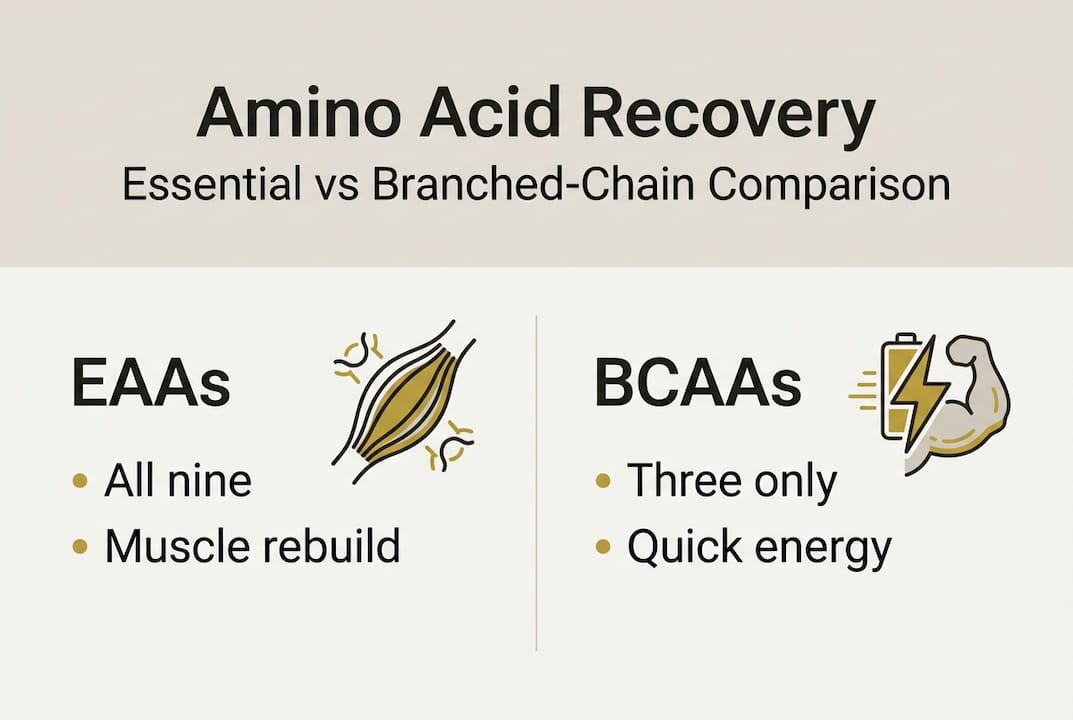
Essential amino acids (EAAs) provide the full spectrum your muscles need to rebuild. Your body cannot produce EAAs on its own, so dietary and supplemental sources are non-negotiable. BCAAs (leucine, isoleucine, and valine) are a subset of EAAs and act more like spark plugs. They initiate the process, but they cannot sustain it alone. Think of EAAs as the complete building crew and BCAAs as the foreman who shows up first.
When it comes to amino acids for recovery, the research on BCAAs during periods of overreaching or high-volume training is particularly compelling. BCAA supplementation reduces muscle damage markers and helps sustain an anabolic hormonal profile when training stress is at its highest.
Here is what the science tells us amino acids do during recovery:
- Stimulate MPS via leucine-driven mTOR activation
- Reduce circulating levels of creatine kinase and lactate dehydrogenase (markers of muscle damage)
- Blunt cortisol spikes that accelerate muscle breakdown
- Support immune function, which is often compromised after intense training
- Accelerate glycogen resynthesis when paired with carbohydrates
“The difference between adequate recovery and optimal recovery often comes down to amino acid precision, not just protein quantity.”
Understanding the muscle health benefits of targeted supplementation means you stop guessing and start engineering your recovery. Comparing EAAs versus BCAAs in the research literature makes it clear that full-spectrum EAA sources consistently outperform isolated BCAAs for sustained MPS.
Pro Tip: If you train fasted or have a long gap between meals and your session, a leucine-rich EAA supplement taken intra-workout can prevent excessive muscle breakdown before you reach your post-workout meal.
Comparing EAAs and BCAAs: which is right for your goals?
Now that you’ve seen the science, let’s compare these two popular supplements head-to-head. The debate between EAAs and BCAAs is one of the most persistent in sports nutrition, and the answer is more nuanced than most supplement labels suggest.
EAAs are superior to BCAAs for muscle protein synthesis because BCAAs cannot sustain synthesis alone. Once leucine fires the starting gun, your muscles need the remaining EAAs to actually complete the repair process. Without them, MPS plateaus quickly.

That said, BCAAs are not without value. Their benefits are simply context-dependent. BCAA supplementation is most effective during calorie deficits, prolonged training sessions, or for athletes consuming low dietary protein. In those scenarios, BCAAs help preserve muscle and reduce soreness when a full EAA or protein source is not immediately available.
| Feature | EAAs | BCAAs |
|---|---|---|
| Supports full MPS | Yes | No |
| Reduces muscle damage | Yes | Yes |
| Best for calorie deficit | Yes | Yes |
| Intra-workout use | Excellent | Good |
| Plant-based athletes | Essential | Partial |
| Cost per serving | Higher | Lower |
For supplements for muscle recovery, here is when to choose each:
- EAAs: Post-workout, fasted training, plant-based diets, or any time you cannot get a full protein meal within two hours
- BCAAs: Intra-workout during sessions over 90 minutes, during a caloric deficit, or as a low-calorie recovery aid between meals
- Both: If you are in a heavy training block with high volume and limited appetite
For most athletes eating adequate protein from quality sources, EAAs will deliver more measurable returns. BCAAs remain a useful tool, but treating them as a standalone recovery solution is where many athletes go wrong.
Pro Tip: Look for an EAA supplement that provides at least 2.5 g of leucine per serving. That is the threshold most research identifies as sufficient to maximally stimulate MPS in healthy adults.
Optimal dosing and timing: how much, when, and how to combine for results
With the major supplement options laid out, it is vital to know how to use them effectively. Getting the dose and timing right can be the difference between your supplement working and it being wasted money.
Endurance athletes need approximately 1.8 to 2.0 g of protein per kg of bodyweight per day, with around 0.5 g per kg consumed post-exercise to optimise MPS. Strength athletes sit at the higher end of this range, particularly during hypertrophy phases.
| Athlete type | Daily protein target | Post-exercise dose |
|---|---|---|
| Endurance | 1.8 to 2.0 g/kg | ~0.5 g/kg |
| Strength/power | 2.0 to 2.2 g/kg | 0.4 to 0.5 g/kg |
| Plant-based | 2.0 to 2.4 g/kg | Leucine-enriched blend |
Follow these steps to boost muscle repair through smart timing:
- Consume 20 to 40 g of high-quality protein or a full EAA dose within one to two hours post-exercise
- Pair protein with carbohydrates (a 3:1 carb-to-protein ratio) to accelerate glycogen replenishment
- Spread protein intake evenly across four to five meals rather than front or back-loading
- Consider a slow-release protein such as casein before sleep to support overnight repair
- For plant-based athletes, enrich meals with leucine powder or choose a blend that hits at least 2.5 g leucine per serving
A useful reference from our supplement timing guide reinforces that evenly distributed protein across the day outperforms the same total intake consumed in one or two large doses. Your muscles can only use so much at once.
Statistic: Athletes who distribute protein evenly across meals and consume it post-exercise consistently show superior MPS responses compared to those who consume the same daily total in fewer sittings.
For plant-based athletes, this is especially critical. Many plant proteins are lower in leucine, so you need either higher volumes or leucine fortification to hit the same anabolic threshold as whey.
Special considerations: sex differences and common recovery pitfalls
Now that you know how to optimise, let us discuss who can benefit most from specific protocols and which mistakes to avoid. Recovery is not one-size-fits-all, and the research is beginning to reflect that.
Men may gain more strength from EAA and BCAA supplementation, while women tend to experience greater recovery benefits such as reduced delayed onset muscle soreness (DOMS). This does not mean one group benefits less overall; it means the primary adaptation differs, and your expectations should be calibrated accordingly.
BCAAs reduce DOMS and muscle damage markers, but the evidence is modest and context-dependent. Relying on BCAAs as your primary recovery tool without adequate total protein is one of the most common mistakes we see.
Here are the pitfalls to avoid:
- Relying solely on BCAAs without ensuring adequate total EAA and protein intake
- Mistiming your protein by skipping the post-exercise window and waiting several hours to eat
- Underdosing consistently, particularly on rest days when repair is actually happening
- Ignoring sleep and carbohydrate intake, which are as critical as amino acids for full recovery
- Assuming all protein sources are equal without checking leucine content
“Recovery is built in the hours after training, not during it. What you consume in that window is the most controllable variable in your programme.”
For female athletes specifically, understanding the importance of recovery supplements beyond just protein shakes is worth exploring. Hormonal fluctuations across the menstrual cycle can affect recovery speed, making consistent amino acid intake even more valuable.
Pro Tip: On rest days, do not drop your protein intake. Muscle protein synthesis continues for 24 to 48 hours after a session, meaning your off-day nutrition is just as important as your training-day nutrition.
Why most athletes overlook the power of precise amino acid strategy
Putting the science and application together, here is the bottom line from a performance perspective. Most athletes are leaving recovery gains on the table not because they are working too hard, but because they are thinking too broadly about nutrition.
“Eat enough protein” is good advice. It is just incomplete. The athletes who recover fastest are not necessarily consuming the most protein. They are consuming the right amino acid profiles at the right times. That distinction is what separates consistent progress from persistent fatigue.
Marketing has done the fitness world a disservice by overstating BCAA benefits for years. BCAAs are easier to sell because they sound specific and scientific. But the sports supplementation strategies that actually move the needle are built around EAAs and leucine-rich complete protein sources, not isolated BCAAs taken in isolation from a broader nutrition plan.
Personalised, evidence-led supplementation is not reserved for elite athletes. It is available to anyone willing to look past the marketing and apply what the research actually shows. Start with your total daily protein, build in EAAs around training, and use BCAAs tactically. That is the framework that works.
Elevate your recovery strategy with targeted amino acid supplements
If you are ready to enhance your recovery, here is how to put these findings into practice. At Elevate Supplements, we have built our product range around exactly the kind of evidence-based nutrition this article covers.
Our EAA supplement delivers the full spectrum of essential amino acids with a leucine-forward profile, designed to support MPS at every stage of recovery. For those who prefer a complete protein source, our whey protein is formulated to hit the leucine threshold your muscles need post-exercise. Both products are built for athletes who want results backed by science, not just marketing. With fast UK and Ireland delivery and free shipping on orders over £100, putting the right amino acids to work has never been more straightforward.
Frequently asked questions
What are the best amino acids for muscle recovery?
EAAs, particularly leucine-rich sources like whey protein, are best for muscle recovery because they provide everything needed to fully sustain muscle protein synthesis, not just initiate it.
How soon after exercise should I take amino acids?
Aim to consume amino acids or a complete protein source within one to two hours post-exercise. Optimal MPS timing is post-exercise, with protein spread evenly across the day for best results.
Can plant-based proteins be as effective for recovery?
Yes, provided they are leucine-enriched. Plant blends are effective at 2.5 g leucine or more per meal, matching the anabolic response of animal-based sources.
Is there a difference in amino acid recovery effects between men and women?
Men tend to see greater strength gains from EAA and BCAA supplementation, while women typically experience more pronounced soreness reduction and recovery benefits from the same protocols.
Recommended
- Amino acids for athletes: boost recovery and performance – ElevateSupplements
- Why use amino acids for better muscle health in 2026 – ElevateSupplements
- 6 Best Supplements for Muscle Recovery: Athlete’s Guide – ElevateSupplements
- Why recovery supplements matter for athletes in 2026 – ElevateSupplements
- Rollen til aminosyrer i hundemat: Hvorfor det betyr noe — Dr-Clauder Norge


