


Whey protein has a reputation problem. Many people still associate it exclusively with bodybuilders chasing massive gains, yet the science tells a very different story. Whether you’re a recreational runner, a CrossFit athlete, or someone simply trying to recover faster between sessions, whey protein offers measurable benefits that extend well beyond the weights room. This article breaks down exactly what whey protein is, how it works inside your body, which type suits your goals, and how to use it effectively to support performance and recovery.
Table of Contents
- What is whey protein?
- Types of whey protein: concentrate, isolate, and hydrolysate
- How whey protein supports muscle growth and recovery
- Practical dosing: when and how much whey protein?
- Potential downsides and who should be careful
- Is whey protein always necessary? The bigger picture
- Find the best whey protein for your goals
- Frequently asked questions
Key Takeaways
| Point | Details |
|---|---|
| Fast-acting muscle support | Whey protein rapidly boosts muscle recovery and growth after training due to its high leucine content. |
| Choose the right type | Concentrate, isolate, and hydrolysate offer different benefits for budgets, tolerances, and performance needs. |
| Timing and dosage matter | Optimal benefits come from 20-40g doses within two hours post-workout and meeting daily protein targets. |
| Be mindful of tolerance | Lactose-intolerant or those with kidney/bone health concerns must select carefully and not exceed recommendations. |
| Diet and training come first | Whey is a helpful supplement, but total nutrition and regular exercise are essential for best results. |
What is whey protein?
Whey protein is one of the most studied supplements in sports nutrition, and for good reason. As a dairy-derived by-product of cheese production, it’s separated from curds during processing and then dried into the powder you find on supplement shelves. What makes it stand out is its speed: whey is absorbed rapidly by the body, delivering amino acids to your muscles quickly when they need it most.
Compared to other protein sources, whey holds a high biological value, meaning your body can use a large proportion of what you consume. Here’s what sets it apart:
- Complete amino acid profile: Contains all nine essential amino acids your body cannot produce on its own.
- High leucine content: Leucine is the key trigger for muscle protein synthesis (MPS), the process that builds and repairs muscle tissue.
- Rapid digestion: Reaches the bloodstream faster than casein or soy, making it ideal around training.
- Versatility: Mixes easily into shakes, oats, and recipes without significantly altering taste or texture.
Casein, by contrast, digests slowly and releases amino acids over several hours. Soy is plant-based and complete, but its leucine content and absorption rate are lower than whey’s.
Types of whey protein: concentrate, isolate, and hydrolysate
Not all whey is created equal. The three main types differ meaningfully in protein content, lactose levels, digestion speed, and cost. Choosing the right one depends on your budget, digestive tolerance, and training demands.
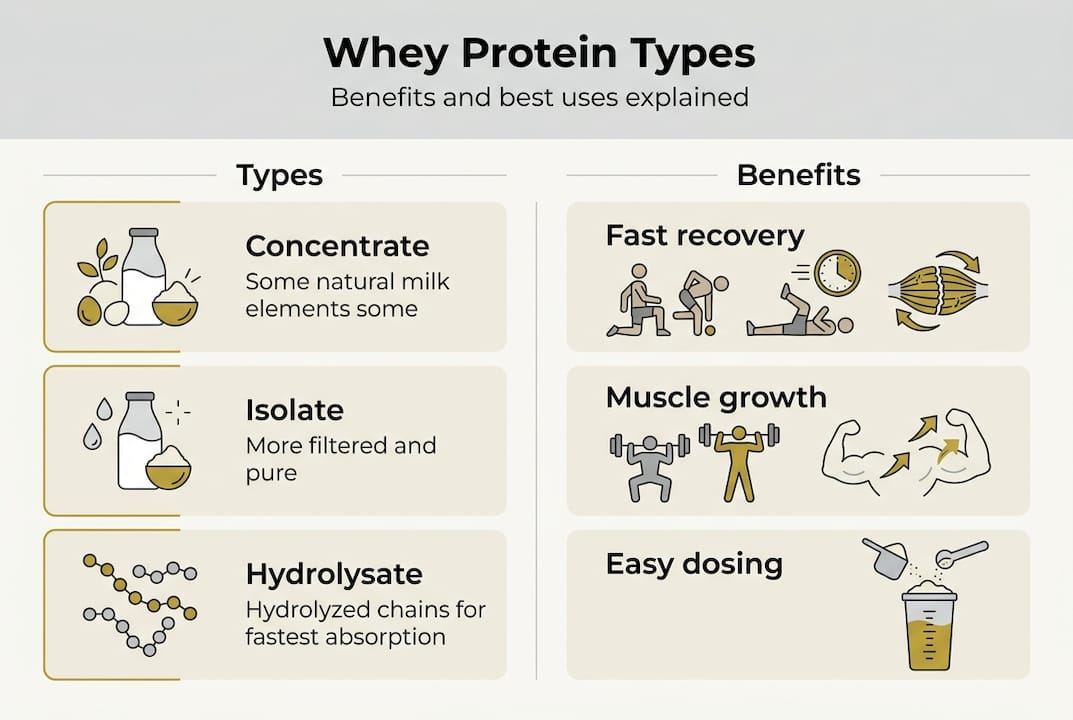
| Type | Protein % | Lactose/fat | Absorption | Cost | Best for |
|---|---|---|---|---|---|
| Concentrate | 70–80% | Moderate | Moderate | Low | General use, budget-conscious athletes |
| Isolate | 90%+ | Very low | Fast | Medium | Lactose sensitivity, lean muscle goals |
| Hydrolysate | 90%+ | Minimal | Fastest | High | Rapid recovery, sensitive digestion |
Concentrate is the most affordable and works well for most people. Isolate suits those who are lactose intolerant or want a cleaner macro profile. Hydrolysate is pre-digested, meaning it hits your bloodstream even faster, though the taste can be more bitter and the price is noticeably higher. If you’re looking for a quality option that balances performance and value, Elevate Whey Protein is worth exploring.
How whey protein supports muscle growth and recovery
The evidence here is compelling. Whey stimulates muscle protein synthesis more effectively than most other protein sources, largely because of its leucine content and rapid absorption. When you train hard, you create micro-tears in muscle fibres. Whey delivers the amino acids needed to repair and rebuild those fibres faster.

A large meta-analysis found that whey supplementation increases fat-free mass (SMD 0.16) and strength (SMD 0.15) compared to placebo. These are statistically meaningful gains, particularly when accumulated over months of consistent training.
| Outcome | Whey group | Placebo group |
|---|---|---|
| Fat-free mass gain | Significantly higher | Baseline |
| Strength improvement | Measurably greater | Minimal change |
| Recovery speed | Faster | Slower |
The timing of whey intake matters too. Post-workout, your muscles are primed to absorb nutrients. Consuming whey in this window accelerates recovery and reduces muscle soreness. For a broader look at how to support this process, our muscle recovery guide covers the full picture. Understanding why recovery matters for athletes is just as important as the training itself. You might also find it useful to explore the omega-3 recovery role in reducing inflammation alongside whey.
Practical dosing: when and how much whey protein?
Knowing whey works is one thing. Knowing how to use it is another. The optimal post-exercise dose sits between 20 and 40g, with daily protein targets for athletes ranging from 1.6 to 2.2g per kilogram of body weight.
Here’s a practical framework to follow:
- Calculate your daily target first. Multiply your body weight in kg by 1.6 (minimum) to 2.2 (maximum). A 75kg athlete needs roughly 120–165g of protein per day from all sources.
- Use whey to fill gaps. If your meals don’t consistently hit your target, a post-workout shake of 25–40g closes the gap efficiently.
- Time it around training. Aim to consume your shake within one to two hours after your session for maximum benefit.
- Adjust for training volume. Endurance athletes and those training twice daily may need to sit closer to the upper end of the range.
- Don’t neglect rest days. Muscle repair continues for 24–48 hours post-session. Maintaining protein intake on rest days supports this process.
Pro Tip: Total daily protein intake consistently matters more than precise timing. If you hit your daily target, a shake 90 minutes post-workout will serve you just as well as one taken immediately. For more on supporting repair between sessions, see our guides on muscle repair supplements and how to cut recovery time naturally. The athlete wellness checklist from AiHealthician is also a useful reference for rounding out your recovery strategy.
Potential downsides and who should be careful
While the benefits are substantial, responsibility means considering limitations and listening to your body’s signals. Whey is not universally suitable for everyone.
- Lactose intolerance: Concentrate contains moderate lactose. Isolate or hydrolysate are better choices for those with sensitivity.
- Kidney health: Those with pre-existing kidney conditions should consult a doctor before significantly increasing protein intake.
- Bone health: High doses over long periods may affect calcium balance in vulnerable individuals.
- Digestive discomfort: Bloating or cramping can occur, particularly with concentrate. Switching to isolate often resolves this.
- Processing effects: Heavy processing can reduce some bioactive compounds found in whey, such as lactoferrin and immunoglobulins.
“Whey protein is highly effective for most active individuals, but those with kidney disease, osteoporosis risk, or lactose intolerance should tailor their choice carefully and seek professional guidance.”
Pro Tip: Start with a half-serving for the first week if you’re new to whey or switching types. This lets your digestive system adapt and helps you identify any tolerance issues before committing to a full dose. Supporting your intake with a well-rounded amino acids and muscle health strategy can also reduce reliance on high whey doses alone. Research on leucine and whey supplementation continues to refine our understanding of optimal use.
Is whey protein always necessary? The bigger picture
With a balanced view, you can decide where whey fits best in your nutrition strategy. The honest answer is: it depends.
“Whey protein is a tool, not a solution. Total nutrition quality and consistent training are what drive long-term results. Whey simply makes hitting your targets more convenient.”
Whey delivers the most noticeable benefits in specific contexts. Research confirms that benefits are most marked in novices and those with nutrient-deficient diets, while seasoned athletes with already-optimised nutrition may see smaller incremental gains.
Who benefits most from whey protein:
- Beginners: Muscle protein synthesis responds strongly to whey in those new to resistance training.
- High-intensity athletes: Those training five or more days per week struggle to meet protein targets through food alone.
- Protein-deficient diets: Anyone not consistently hitting 1.6g/kg daily will see clear improvements.
- Time-pressed individuals: A shake is faster and more convenient than preparing a high-protein meal post-session.
- Older athletes: Muscle loss accelerates with age; whey’s leucine content helps counteract this.
If your diet is already rich in quality protein sources and your training is moderate, whey becomes a convenience tool rather than a necessity. For a broader view of how supplementation fits into performance, our guide on sports supplementation for performance is a solid next step.
Find the best whey protein for your goals
You now have a clear, evidence-based understanding of what whey protein does, how to use it, and whether it suits your situation. The next step is putting that knowledge into practice with a product you can trust.
At Elevate Supplements, our Elevate Whey Protein is formulated to deliver a high-quality amino acid profile with great mixability and taste, supporting your training goals whether you’re building muscle, improving endurance, or simply recovering faster. Pair it with our essential amino acids for a more complete recovery stack that covers both intra and post-workout nutrition. We offer fast UK and Ireland delivery, free shipping on orders over £100, and a straightforward returns process so you can shop with confidence.
Frequently asked questions
Is whey protein safe for daily use?
For most healthy adults, daily whey protein use within recommended doses is safe as part of a balanced diet. However, high long-term doses may pose risks for those with kidney or bone health concerns.
Does whey protein help with weight loss?
Whey can support fat loss by increasing satiety and preserving lean muscle within a calorie-controlled diet. Research shows it increases fat-free mass and improves body composition compared to placebo.
Can lactose-intolerant people consume whey protein?
Yes. Whey isolate and hydrolysate contain minimal lactose and are generally well tolerated. Isolate or hydrolysate are the recommended choices for those with lactose sensitivity.
Which is better: whey or casein?
Whey is superior for post-workout recovery due to its rapid absorption and leucine content. Casein digests slowly and is better suited to overnight muscle repair.
How soon after training should I take whey protein?
Aiming for 20–40g of whey within one to two hours post-exercise is the most effective approach. This window maximises muscle protein synthesis and accelerates recovery between sessions.
Recommended
- What is creatine? Benefits, science and safe use explained – ElevateSupplements
- Why use amino acids for better muscle health in 2026 – ElevateSupplements
- Pre-workout supplement types for peak performance guide – ElevateSupplements
- Role of Supplements in Wellness: Performance and Recovery – ElevateSupplements


