


TL;DR:
- Recovery supplementation accelerates muscle repair, glycogen replenishment, and inflammation management.
- Evidence supports core supplements like protein, creatine, omega-3s, electrolytes, and tart cherry juice.
- Proper timing and personalized routines enhance recovery, with focus on quality, consistency, and strategic adjustments.
Rest is essential, but if you believe it alone is enough to recover from hard training, you’re leaving serious gains on the table. Recovery supplementation refers to the use of dietary supplements to accelerate post-exercise recovery processes, and the science behind it is compelling. From reducing delayed onset muscle soreness to restoring glycogen and managing inflammation, targeted supplements can meaningfully cut your downtime between sessions. This article covers the core supplements with real evidence behind them, the science of timing, how to personalise your approach, and a practical framework you can start using immediately.
Table of Contents
- Defining recovery supplementation: purpose and process
- Core supplements: what works and why
- Timing and mechanisms: how supplements aid recovery
- Personalisation, myths, and emerging trends
- Practical frameworks: building your optimal recovery routine
- A fresh perspective: why smart recovery isn’t about more, but better
- Level up your recovery with ElevateSupplements
- Frequently asked questions
Key Takeaways
| Point | Details |
|---|---|
| Science-backed basics | Focus on proven supplements like protein, creatine, and electrolytes for optimal recovery. |
| Timing matters | Immediate post-exercise intake of key nutrients maximises repair and reduces fatigue. |
| Beware supplement myths | Avoid common pitfalls like overdoing antioxidants or chasing unproven trends. |
| Personalise for results | Adjust your routine based on your sport, body, and lab feedback for best outcomes. |
Defining recovery supplementation: purpose and process
Recovery supplementation is not the same as general nutrition. Everyday eating supports baseline health, but recovery supplementation is intentional. It targets specific physiological processes that are triggered by exercise and need support to resolve efficiently.
When you train hard, your body moves through a predictable sequence of events. Acute inflammation kicks in within minutes. Muscle protein synthesis ramps up. Glycogen stores are depleted. Electrolytes are lost through sweat. Without targeted input, these processes resolve on their own timeline, which is rarely fast enough for athletes training multiple times per week.
As noted in research on physiological recovery mechanisms, “recovery supplementation refers to the use of dietary supplements to accelerate post-exercise recovery processes in athletes and fitness enthusiasts.” That acceleration is the point.
Here is what recovery supplementation is designed to do:
- Support muscle repair and protein synthesis after resistance or endurance training
- Replenish glycogen stores depleted during prolonged or high-intensity effort
- Reduce excessive inflammation and oxidative stress that prolongs soreness
- Restore electrolyte balance lost through sweat
- Shorten the time between sessions without compromising adaptation
Recovery supplementation is not about replacing meals or masking fatigue. It is about giving your body the precise inputs it needs, at the right time, to repair faster and come back stronger.
The distinction matters because many athletes either over-rely on supplements instead of eating well, or they dismiss supplements entirely and miss genuine performance gains. Learning to boost muscle repair through targeted supplementation sits between those two extremes. For a broader overview, the best recovery supplements guide is a solid starting point.
Core supplements: what works and why
Not all supplements are created equal. The market is full of products making bold claims, but a much shorter list has genuine research behind it. Let’s focus on what actually moves the needle.
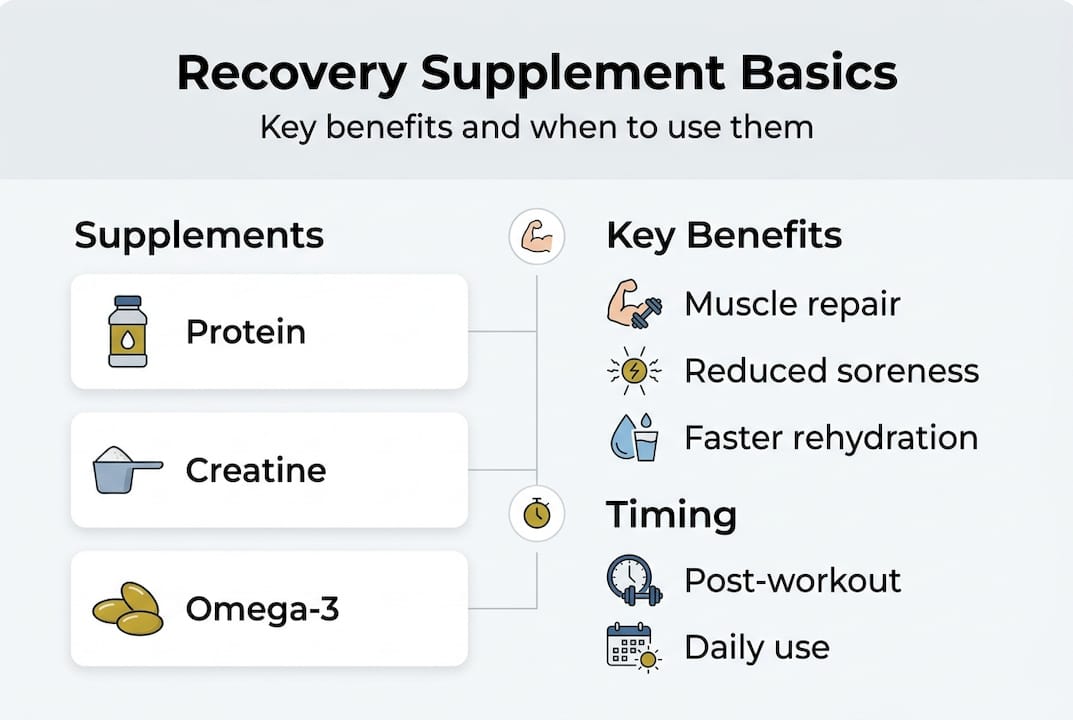
Evidence-based recovery supplements consistently identify five Tier 1 options: protein, creatine, omega-3 fatty acids, electrolytes, and tart cherry juice. These are the ones with robust data across multiple populations and training types.
| Supplement | Primary benefit | Optimal timing | Typical dose |
|---|---|---|---|
| Whey/casein protein | Muscle repair and synthesis | Immediately post-exercise | 20 to 40g |
| Creatine monohydrate | Power output and session recovery | Daily, any time | 3 to 5g |
| Omega-3 fatty acids | Inflammation reduction | With meals, daily | 2 to 4g EPA/DHA |
| Electrolytes | Hydration and nerve function | During and after training | Per sweat rate |
| Tart cherry juice | Soreness and sleep quality | Pre-sleep or post-workout | 30ml concentrate |
Protein is the cornerstone. Whey absorbs quickly, making it ideal immediately after training. Casein digests slowly, which makes it useful before sleep when overnight muscle repair is the goal. Creatine is one of the most studied sports supplements in existence and consistently improves recovery between sessions at high intensities. Omega-3s work on a longer timeline, reducing systemic inflammation with daily use rather than acute dosing.
Electrolytes are often underestimated. Sodium, potassium, and magnesium losses during training affect muscle contraction and recovery quality. Tart cherry juice is the dark horse of the group. It contains anthocyanins that reduce muscle damage markers and also supports sleep, which is when most repair actually happens.
Pro Tip: Focus your supplement budget on what the evidence supports. Trendy new products with flashy marketing and vague claims rarely outperform the basics. Master the fundamentals first, then explore additions once your foundation is solid. Check the muscle recovery guide and prioritise supplement quality when making purchases.
Timing and mechanisms: how supplements aid recovery
Knowing which supplements work is only half the picture. When you take them shapes how much benefit you actually receive.

A meta-analysis on supplement timing found that immediate post-exercise protein and carbohydrate intake is superior for muscle and glycogen recovery and fatigue reduction compared to delayed intake. That finding has practical implications for every training session you complete.
Here is how the recovery timeline maps to supplementation windows:
- 0 to 30 minutes post-exercise: Prioritise fast-absorbing protein and simple carbohydrates. This is when muscle membranes are most permeable and glycogen synthase activity peaks.
- 30 to 90 minutes: Continue hydration with electrolytes. Inflammation is peaking. Omega-3s taken daily are already working in the background.
- 2 to 4 hours post-exercise: A whole-food meal with protein and complex carbohydrates sustains muscle protein synthesis.
- Pre-sleep: Casein protein and tart cherry juice support overnight repair and sleep quality simultaneously.
The body does not recover in a single moment. It is a cascade of overlapping processes, and each supplement has a window where its impact is greatest.
Creatine works differently. It does not need to be timed around training. Daily loading of 3 to 5g maintains muscle creatine saturation, which means your ATP regeneration between sets and between sessions is consistently supported. For a deeper look at supplement timing for recovery, the evidence is clear: consistency matters more than perfection. Understanding the role of amino acids in this cascade is also worth exploring, particularly for those doing high-volume training.
Personalisation, myths, and emerging trends
Even with the right supplements and timing nailed down, there are persistent myths that can derail your approach. Let’s address them directly.
The so-called “anabolic window” is one of the most overstated concepts in sports nutrition. Research confirms that the anabolic window is much wider than the supposed 30-minute rule, and some antioxidants may actually blunt adaptation when taken in high doses around training. Flooding your system with Vitamin C and E post-workout sounds logical, but it can interfere with the very cellular signalling that drives long-term strength gains.
Here is a comparison of core versus emerging supplements:
| Supplement | Evidence strength | Key benefit | Potential drawback |
|---|---|---|---|
| Whey protein | Very strong | Muscle synthesis | Lactose intolerance in some |
| Creatine | Very strong | Power and recovery | Initial water retention |
| Collagen peptides | Moderate | Joint and tendon support | Incomplete amino acid profile |
| HMB | Moderate | Muscle preservation | Expensive, mixed results |
| L-carnitine | Weak to moderate | Fat metabolism | Limited recovery evidence |
| NMN | Emerging | Cellular energy | Long-term data lacking |
Personalisation is becoming increasingly important. Sex differences in recovery, individual training adaptation phases, and blood marker monitoring all influence which supplements will actually help you. What works brilliantly for a male endurance athlete may be less relevant for a female strength athlete in a different training block.
Pro Tip: Start with what is proven, track your response honestly, and use lab markers where possible. Do not chase trends. Supplement stacking can amplify results, but only when the individual components are already validated for your goals. Explore sports supplementation trends critically, and always cross-reference with natural supplements for recovery that have stood the test of time.
Practical frameworks: building your optimal recovery routine
All the science in the world is only useful if you can translate it into a consistent daily practice. Here is a step-by-step framework to build your recovery routine from the ground up.
- Identify your training type. Strength, endurance, and cross-training have different recovery demands. Prioritise accordingly.
- Set supplement priorities. Start with protein and creatine. Add electrolytes if you sweat heavily. Introduce omega-3s for daily inflammation management.
- Plan your timing. Map each supplement to the appropriate window in your post-exercise timeline.
- Track and adapt. Monitor soreness, sleep quality, and performance over two to four weeks. Adjust based on real feedback, not assumptions.
As recovery supplementation benchmarks confirm, creatine improves recovery between sessions, protein accelerates muscle growth, and electrolytes are particularly critical for endurance athletes. These are not optional extras. They are functional inputs.
| Training type | Priority supplement | Secondary supplement | Key timing |
|---|---|---|---|
| Strength and power | Creatine, whey protein | Omega-3s | Immediately post-session |
| Endurance | Electrolytes, carbohydrates | Tart cherry juice | During and post-session |
| Cross-training | Whey protein, electrolytes | Creatine | Post-session and daily |
Supplementation does not work in isolation. Sleep, whole-food nutrition, and stress management are the foundation. Supplements amplify what is already working. If you are sleeping poorly and eating erratically, no stack will compensate. For more on why recovery supplements matter within a broader wellness context, the evidence is consistent: they are tools, not shortcuts.
A fresh perspective: why smart recovery isn’t about more, but better
Here is something most supplement adverts will never tell you: taking more supplements does not mean recovering better. We see this pattern repeatedly. Athletes stack product after product, spending heavily, and then wonder why their results plateau or their digestion suffers.
The uncomfortable truth is that over-supplementation is common, and it often creates noise that makes it harder to identify what is actually working. When you are taking eight different products simultaneously, you cannot isolate cause and effect. You are guessing.
The smarter approach is to build your stack methodically. Start with the Tier 1 options. Give them six to eight weeks to show results. Track markers that matter: performance, soreness, sleep, and where possible, blood work. Then make informed additions or swaps.
Supplements enhance recovery. They do not replace sleep, quality food, or intelligent programming. The athletes who get the most from their supplementation are not the ones taking the most. They are the ones who have chosen carefully, applied consistently, and reassessed regularly. Consider cycling supplements for results as part of that reassessment process. Precision beats volume every time.
Level up your recovery with ElevateSupplements
Ready to put proven recovery supplementation into action? ElevateSupplements makes it straightforward.
Our curated Perform & Recovery Stack brings together the evidence-based essentials covered in this article, so you are not piecing together a routine from scratch. For targeted recuperation support, including advanced formulations for tissue repair and inflammation management, explore Recuperation Support. Every product at the ElevateSupplements store is selected for quality and efficacy, with fast UK and Ireland delivery, free shipping on orders over £100, and 24/7 customer support. Your recovery starts here.
Frequently asked questions
Can recovery supplements replace proper diet and rest?
No. Supplements complement but do not replace fundamentals like nutrition and sleep. They work best as targeted additions to an already solid recovery foundation.
What is the best time to take recovery supplements after exercise?
Immediate post-exercise intake of protein and carbohydrates offers faster recovery compared to delayed intake, making the period right after training the most impactful window.
Are novel or trending supplements worth trying for recovery?
Most athletes should prioritise evidence-based options first. Emerging supplements lack robust evidence and some show controversial findings, so they are best explored once your core stack is established.
How much protein should athletes aim for in recovery?
Endurance athletes typically require around 1.8g protein per kg of bodyweight daily, though strength athletes may benefit from slightly higher intakes depending on training volume.
Recommended
- Why recovery supplements matter for athletes in 2026 – ElevateSupplements
- Maximise recovery: the essential role of amino acids – ElevateSupplements
- Sports supplementation: boost performance, recovery and wellness – ElevateSupplements
- Why stack supplements for peak performance and recovery – ElevateSupplements


